How I avoid writing on a typical day

When I sat down to write this, I had a cup of coffee which I needed to drink first. My brain was too tired and moving too slowly to be productive at all. Since I couldn’t write while drinking coffee, I decided to browse facebook. On facebook, I looked at old pictures and saw how thin my face used to be. Then I looked in the mirror to see how round it had become. My eyelids looked heavy (from the lack of caffeine), my skin pale and blotched from acne scars, and my lips were cracked. I was distracted by my appearance. I felt ugly and unproductive, so obviously I had to take a shower. I wanted to feel really good so I took a long time showering. I let my skin soak in all the hot water, then I scrubbed with a loofa until I was covered in milky peach-scented suds. I shaved carefully, using shaving cream and a fresh razor. I returned to my computer in my robe, having decided to let my hair air-dry. But then it gave me the chills so I had to blow-dry it. Then I had to curl it, otherwise it would look bad for the rest of the day.

Since I did my hair, I had to do my makeup, though I did it quickly (powder, blush, mascara). Then I had to get dressed. I wanted to be comfortable, but I didn’t want to have to change later, so I chose a favorite pair of jeans and a sweater.

Then I sat down to write. By then, my coffee had grown cold and I needed to get a fresh cup. My brain still wasn’t awake, but I forced myself to write anyway.

While I was writing, I was distracted, worrying about the weather for the rest of the week. Then I thought about the piece I had worked on a few weeks back and decided to return to that draft. If I was going to get anything published, it needed to be polished and that was the closest complete piece I had.

But I had started this piece and I didn’t want to lose focus, so I continued writing this one, the one about the miss to ma’am business, the essay that’s been floating around in my head for the last month or so. So I continued with this one, though I wasn’t happy with how the setting was described. I needed the coffee shop to come alive. I needed the high school boys to be both vivid characters and essential components of the setting. But I just needed it to get out, I would return to it later, so I moved onto the dialog. The dialog read like the conversation, but there was too much white space.

There’s always too much white space with my dialog. It’s a cheap way to get the page count up, right?

Then I moved onto the pinnacle moment, the point where I cease to feel like a girl and begin to feel like a woman. There’s that moment, not of intersection or overlap, but a vacuum of a moment, in which there is no sense of self, only questioning. I wanted to describe that moment, that void of identity, but I couldn’t do it. I thought of describing the way my toes were squeezed into my shoes or about how I used to wiggle a utensil between bites in hopes that might illustrate the anxiety a girl feels when her sense of self is changing demographics. But it wasn’t working.

So I said I would return to it. I knew what would come next. I knew the strange boy needed to say that thing about my shoes and that the other one would tease him, and that Heather would say something dumb, so I could write that in later. I would return to it. Hemingway would always stop at a point where he knew what would happen next. In a sense, he never had a “complete” writing session, just thousands of them threaded together by thoughts and ideas. Brilliant bastard.

At this point, it looks more like a short story, but it’s not supposed to be. It’s supposed to be a personal essay, so I should be reflecting, shouldn’t I? So I tried to muse a little bit. I mused about femininity and what it meant to be a girl and what it meant to be a woman. The result was a pathetic list of self-indulgent behaviors that made me realize that despite the fact I’m 24, according to my own list of qualifiers, I’m very much a girl and not a woman.

So then I looked in the mirror and saw a girl, and I decided to make myself look like a woman. I tried to put on lipstick, since that’s a thing women do, and found that I don’t know how to apply it. So I watched five videos on youtube about how to get the perfect red lips. I reapplied the lipstick to find that I don’t like how I look with lipstick. And that I hate the way it feels – like a thin layer of half-dried Elmer’s glue that eventually sucks all the moisture out of my lips.

Then I sat and wondered what the harm was in being a girl and not a woman. Girls just want to have fun. Women just want to have babies. Right? Isn’t that the real difference?

Two hours after sitting down with the initial cup of coffee, I decided I had done enough work. I had left off at a Hemingway stopping point anyway, so I would have no problem returning to get some real work done the next day.

Right?

My life as I know it will be over.

I had a strange realization the other day, one that shouldn’t exactly be a realization. As of December 16, I’m no longer going to be a college student.

It’s all I’ve done for the last five years. I’m having an existential crisis. Am I entitled to that?

I’m preparing to go visit Bill in a few days. In fact, I will be seeing him in just over 48 hours. I haven’t seen him since September. It’s been over two months since I’ve kissed him, hugged him, touched him, or woke up to him talking in his sleep. I’m flying into Oklahoma City around 10pm on Tuesday night. I’ve never gotten off an airplane to be greeted by a boyfriend. I’ve been trying to imagine the scene. I’m sure I’ll be tired since I’m working in the morning, and traveling by plane is oddly exhausting. However, if I don’t have a five year old kicking the back of my seat like my last flight, I’ll consider this one a success. I’ll exit the terminal and search for Bill, hauling my carry on bag and rolling suitcase and then I’ll see him and cry. Big gooey tears that are embarrassing but I won’t care because I’ll finally actually be seeing Bill in the flesh rather than on my computer screen and for the first time in months my tears will be on his shirt and not on my sleeve.

But maybe I won’t cry. Maybe I’ll just smile till my cheeks hurt and then we’ll kiss and I’ll blush for the rest of the night. 

Because I’m not there yet, I’m wanting the next two days to pass by as quickly as possible. I’m becoming acutely aware of how swiftly time moves. I’ll be in Oklahoma for about a week, then after that, I’ll have just three weeks left as a college student. That means I will be cramming an enormous amount of work into three weeks. I have several books I need to read. While I’m doing this, I need to read critically so I can write a comparative paper for my African American Women Writers class – I’m thinking of comparing a Lorrie Moore story with one of Danielle Evans’s stories. Which two stories, I’m not sure. I read Moore’s Self Help a few months ago, and I’m not through Evans’s collection. I’m anticipating that by rereading Moore’s book and completing Evan’s collection, I’ll have a sudden epiphany and I’ll write a brilliant paper. I also need to write a paper about Pat Barker’s Regeneration, which as far as I can tell, 2/3 of the way through, has no plot. So far I’ve picked up a few things about a stuttering psychiatrist who has some homosexual tendencies and a few WWI soldiers getting day passes. It’s really a pretty boring book and because it’s near impossible to finish reading, I’m going to have a very difficult time writing about it. I also have to finish a draft of my seminar project – a piece of creative nonfiction that’s turning into a pretty personal endeavor – and then revise it until it’s wonderful.

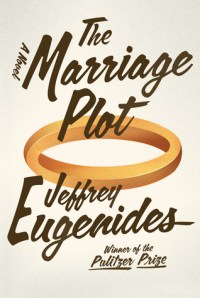
While I have all of these books to read and also biology and anthropology to study, I decided to read another book. The Marriage Plot by Jeffrey Eugenides. An editorial review on Amazon reads:

Even among authors, Jeffrey Eugenides possesses a rare talent for being able to inhabit his characters. In The Marriage Plot, his third novel and first in ten years (following the Pulitzer Prize-winning Middlesex), Eugenides describes a year or so in the lives of three college seniors at Brown in the early 80s. There is Madeleine, a self-described “incurable romantic” who is slightly embarrassed at being so normal. There is Leonard, a brilliant, temperamental student from the Pacific Northwest. And completing the triangle is Mitchell, a Religious Studies major from Eugenides’ own Detroit. What follows is a book delivered in sincere and genuine prose, tracing the end of the students’ college days and continuing into those first, tentative steps toward true adulthood. This is a thoughtful and at times disarming novel about life, love, and discovery, set during a time when so much of life seems filled with deep portent.

The “tracing the end of the students’ college days and continuing into those first, tentative steps toward true adulthood” bit was the thing that really sold me. I’ve been sort of obsessed with books like this lately. I want how-to texts to tell me how to be an adult, because I don’t really know what it’s like to not be a student. I’m no longer looking to books for escapism – I’m looking to them for comradery, even if the heroines of these fictions don’t figure it out. Lorrie Moore’s characters are usually women just on the verge of a breakdown, and the Madison-area college student in A Gate at the Stairs felt like a best friend on the pages. About thirty pages into The Marriage Plot, I’m beginning to wonder when Eugenides was able to notate my thoughts while I sat through my English classes. Consider such gems like:

She’d become an English major for the purest and dullest of reasons: because she loved to read. (pg 20, from the Kindle edition)

That left a large contingent of people majoring in English by default. Because they weren’t left-brained enough for science, because history was too dry, philosophy too difficult, geology too petroleum-oriented, and math too mathematical—because they weren’t musical, artistic, financially motivated, or really all that smart, these people were pursuing university degrees doing something no different from what they’d done in first grade: reading stories. English was what people who didn’t know what to major in majored in. (pg 21, from the Kindle edition)

But after three solid years of taking literature courses, Madeleine had nothing like a firm critical methodology to apply to what she read. Instead she had a fuzzy, unsystematic way of talking about books. It embarrassed her to hear the things people said in class. And the things she said. I felt that. It was interesting the way Proust. I liked the way Faulkner. (pg 24, from the Kindle edition)

I’m really hoping that Madeleine ends up figuring her life out so I can follow suit. However, since it’s a Eugenides novel, she’ll probably have a much deeper existential meltdown, then commit suicide or her whole family will die. Don’t worry though, it will be done in the most brilliant of fashions.

If I were really smart, I would save this and any other leisure reading material for December 17.

I am an excellent college student.

I have this condition. I find I’m willing to do anything other than whatever it is that I need to do. I’m supposed to be reading The Dying Ground, which is a hip hop novel for my African American Women Writers class (from here on known as AAWW) . Don’t ask me what a hip hop novel is because I don’t know – I haven’t started reading it yet. I’m supposed to have ten chapters read by at 1:20 tomorrow afternoon. I’m also supposed to finish reading Lorine Niedecker’s collection of poetry, but as I found out last week, it takes about ten minutes to get through 50 pages of imagist poetry, and there’s no need to really understand it anyway. I’m not expecting this novel to be bad. I’m not expecting to hate it. I would just rather do anything else, including reorganizing my music files on my computer, watching two seasons of House (I watched the first episode of the season and have no idea how he ended up in prison), making sure there are no typos in my history or biology notes, reading ahead in my anthropology textbook, or reading the case study on the Yanomamo: A Fierce People. I read the first twenty pages last night.

A high capacity for rage, a quick flash point, and a willingness to use violence to obtain one’s ends are considered desirable traits. Much of the behavior of the Yanomamo can be described as brutal, cruel, treacherous, in the value-laden terms of our own vocabulary. The Yanomamo themselves, however, as Napoleon Chagnon came to intimately know them in the year and a half he lived with them, do not all appear to be mean and treacherous. As individuals, they seem to be people playing their own cultural game, with internal feelings that at times may be quite divergent from the demands placed upon them by their culture. This case study furnished valuable data for phrasing questions about the relationship between the individual and his culture.

The Yanomamo appear to be constantly on the verge of extranormal behavior, as we define it, and their almost daily use of hallucinogenic drugs reinforces these drives to what might seem to the outside observer to be the limits of human capacity. Life in their villages is noisy, punctuated by outbursts of violence, threatened by destruction by enemies. To the ethnographer it is frightening, frustrating, disgusting, exciting, and rewarding, and in this case study the ethnographer lets the reader know how he feels. His honest reaction helps us, as interested outsiders, to know the Yanomamo.

You can’t tell me that doesn’t sound interesting. Here are these people, living in small groups, doing drugs and attacking each other. It sounds full of that sensational crap that gets my attention whenever I flip past the Discovery Channel and they’re having a marathon of shows on human sexuality.

Midterms are overwhelming. I had two tests this morning – history and biology. I crammed for both of them over the course of the last three nights because I am a smart person. Neither test was very bad, but as I’ve made it clear, my mind practically refuses to retain scientific information, especially when describing things like cell division and the Calvin cycle. I think they mentioned ATP and NAD+ somewhere in there, but I’m not sure about the significance.

I completed a take home test for AAWW. It was an essay and it enabled me to bust out my amazing outlining skills. I really hope that’s a skill employers look for, because I am great at it. Now, all I need to do is read, but instead I’d rather document my procrastination skills on my blog.

I am an excellent college student.

Dear Wonderful Boyfriend

As a rule, I hate Facebook ads. Facebook is a huge timesuck and I wish I could delete it. For NaNoWriMo, I think I might. Since I have an Android phone, that’s how my contacts are all synced up, but I’m sure I can find a way to get around that and to completely delete Facebook off my phone as well.

Anyway, to throw off the people at Facebook, I go through phases where I will mark all the ads as “offensive” or “sexually explicit”. I could see the ads getting more and more desperate – grasping at anything that I might be interested in. This included things like Modcloth, vintage engagement rings, shoe subscription services (Surprisingly, I don’t want to get a new pair of Kim Kardashian shoes every few weeks), and classes to be an ultrasound tech. Nowhere on my profile do I claim to like dresses, jewelry, or shoes, so I think they just said, “Well, she’s a girl, so let’s throw this crap at her.”

I do, however, have my favorite authors and tv shows listed, so that’s about all they have to go off of until I write on a friend’s wall, mentioning champagne and all the ads on the side change to things about cocktails and drunk driving attorneys (yes, that happened). Last week, they gave me an ad about David Sedaris performing at the Overture Center in Madison. I did not mark this ad sexually explicit or offensive. I clicked on it.

Because I’m broke, I couldn’t justify the cost. However, I told Bill about it, and he said he’d be more than happy to buy a ticket for me if I could get down there. So, I will be borrowing a parent’s car and getting to Madison on October 28 to see my favorite author do a reading.

After Bill bought the ticket, he told me this was conditional. He probably should have said that before purchasing the ticket, but whatever. He said that he got me the ticket under the condition that I find some way to interact with him while I was there. This didn’t mean clapping after he finished reading an essay, I’m assuming. Of course I agreed to it, because that’s a perfectly reasonable and fantastic condition. If there is a book signing or meet and greet, I will stay in line for as long as security will allow.

I feel like I need a game plan. What do I talk to him about? He’s a pretty successful author, and I’m sure there are plenty of people who talk to him saying, “I LOVED that essay and then I copied it, but not before decorating my living room in a conspiracy-hunting psychotic style with your and Hugh’s pictures.” And that is not something I will say. I’m not psychotic and I have no idea what Hugh looks like. I think my best bet is to mention the “Old Faithful” essay (see my previous post), or ask him about “Repeat After Me” and how his writing has affected his family.

Let’s hope that I develop a plan and actually stick to it instead of bumbling like an idiot, “Your books good. I read lots and laugh loud.”
That’s what I imagine myself doing, but perhaps I can fight my instincts for once.