Embarking on Infinite Jest

Amazon Kindle has David Foster Wallace’s Infinite Jest for $4.99 right now. I was going to buy it a few months ago, but I was already reading three books I had just purchased and I couldn’t justify spending another $9.99 on a book I wouldn’t read for a month. But I bought it yesterday. And I had ten minutes between work and teaching a lesson to read Dave Eggers’s introduction.

If you don’t know anything about Infinite Jest, I’ll fill you in. It’s a 1,079 page satirical (postmodern, tragicomedy, sci-fi, etc) novel that takes place in a future version of North America where corporations purchase rights to each calendar year (Year of Glad, Year of the Depend Adult Undergarment, etc). The novel touches on depression, popular culture, advertising, family, addiction, and just about everything else, including tennis.
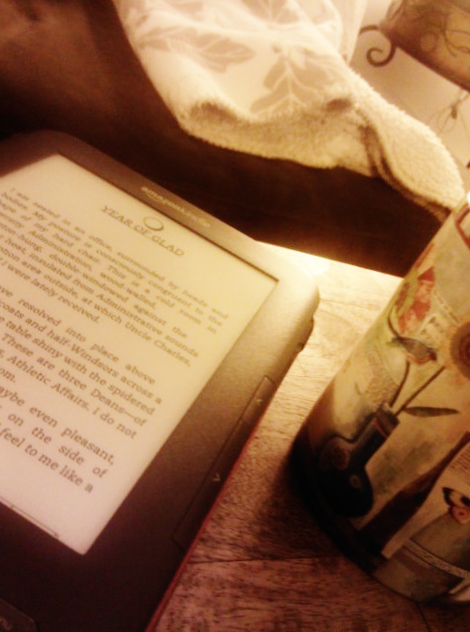
It’s basically a beast. And I’ve been hesitant to start reading it because it’s the size of the bible (but way more entertaining), and because I’ve heard that while DFW’s fiction is extremely rewarding, it is difficult to read.

Anyway, I purchased it on a whim and read the introductory essay by Dave Eggers and got really excited when I read this:

Is it our duty to read Infinite Jest? This is a good question, and one that many people, particularly literary-minded people, ask themselves. The answer is: Maybe. Sort of. Probably, in some way. If we think it’s our duty to read this book, it’s because we’re interested in genius. We’re interested in epic writerly ambition. We’re fascinated with what can be made by a person with enough time and focus and caffeine and, in Wallace’s case, chewing tobacco. If we are drawn to Infinite Jest, we’re also drawn to Magnetic Fields’ 69 Songs, for which Stephin Merritt wrote that many songs, all of them about love, in about two years. And we’re drawn to the ten thousand paintings of folk artist Howard Finster. Or the work of Sufjan Stevens, who is on a mission to create an album about each state in the union. He’s currently on State No. 2, but if he reaches his goal, it will approach what Wallace did with the book in your hands. The point is that if we are interested in human possibility, and we are able to cheer each other on to leaps in science and athletics and art and thought, we must admire the work that our peers have managed to create. We have an obligation, to ourselves, chiefly, to see what a brain, and particularly a brain like our own – that is, using the same effluvium we, too, swim through – is capable of.

As soon as I read that paragraph, I wanted to call and cancel my student’s lesson, stay in that park and read. But I didn’t. Three hours later, I’m finally home and I’m able to make myself a cup of tea, grab a blanket, and sit on my couch with my Kindle and read.

If you’re interested in learning more about David Foster Wallace, check out this BBC interview.

A Million Little Pieces, Memoir, and Honesty

I was up at 6am today. Not as terrible as 5am, but on labor day, that’s still a pretty crappy time to be awake. I went for another run, followed by some yoga. Then I sat on my patio for a nice breakfast and reading session. I finished The Marriage Plot and was pretty disappointed. I had such high expectations after Middlesex, so my disappointment was inevitable.

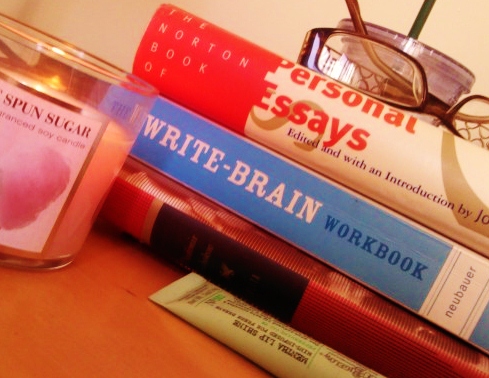
I’m trying to find something to read next, which is sort of funny all on its own. About a quarter of the books on my shelf haven’t been read. A customer from the coffee shop I used to work at gave me the The Letters of Anton Chekhov. That seems like a nice thing to read, right? Meh. I went through a phase a few years ago when I was obsessed with Chekhov. I ripped through a collection of his short stories in a week (probably the same week the customer gave me the book), and haven’t picked up a story or play of his since. Had I read his letters right after those short stories, I probably would have gotten some insight into his life and personality, and I probably really would have appreciated it. Now? Nah. I also have the Norton Collection of Personal Essays that I found at a used book store for $7, but I’m trying to stay away from shorter works.

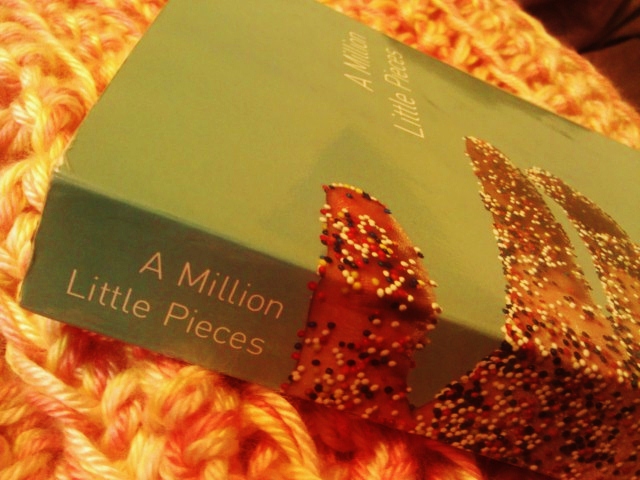
I wandered over to Carissa’s shelves today and found A Million Little Pieces. I don’t know much about the book other than it claimed to be a memoir and ended up being false. Also, something about drugs. And Oprah.

When this book blew up, I wasn’t interested in memoir. I sort of regarded it as a lame fad: just uncreative and self-indulgent people who wanted to write but couldn’t write fiction. I was a Fiction Writer, interested in the construction of character and plot. Then I took a memoir-writing class at UW-Milwaukee and that changed. I realized that my fiction elitism was unwarranted since I was an unrealized memoirist at heart, what with my incessant journaling (I did more digging, my journaling slowed most during my junior and senior years of college). Then I started reading memoirs and essays and found that I loved how truth could be stranger than fiction.

So I have mixed feelings about A Million Little Pieces. Now that I write memoir I’m aware that I have an obligation to be honest. I had a few autobiographical fiction assignments in college, and I was so confused about them. I allowed myself fictional retribution – ending a relationship when I should have, dumping beer on his belongings, wildly advertising his infidelity, slapping him more than just the one time, etc – but it felt sort of dirty. I was telling a story that had its roots in reality, but then ended it falsely. If my ex were to read it, he would surely point out all the fiction, expose me as a fraud, humiliate me, etc. And I would know he was right.  I would face similar consequences if I paraded the story as fiction, only in a weirder inverted way.

If I were to ever share those pieces, I think I would need to preface them with a disclaimer: “The following events are based in reality, though I’ve taken the liberty of replacing certain details and/or the ending with ones preferable to me.” And really, who cares then? The truth probably offers a better story than the one I give anyway. Maybe I’ll clean one up and share it later this week, then you can tell me what you think.

Anyway, reading a fictionalized memoir is going to be an interesting experience. I’m going to have to tell myself it’s a novel if I don’t to feel completely cheated by the end of it.

On My Amazon Recommendations

For Valentine’s Day earlier this year, Bill got me a Kindle. It was actually a Valentine’s Day/Birthday gift, but it sounds better if I just say it was Valentine’s Day gift.  (Come on boyfriend, you should be showering me with gifts every chance you get.) I was thrilled to get it, and it’s since become my single favorite object. Every now and then I’ll swoon over how wonderful it is and I tell Bill, “I just love it so much. I want to tell everyone about it.” I’m not exaggerating when I say that I use it everyday or that I carry it with me everywhere I go. I’ve only forgotten it twice, and both times, I found myself stranded without reading material and having a minor panic attack until I realized I could read books with the Kindle app on my phone.

Since I do most of my reading on my Kindle, Amazon has a good record of the books I like. To find new books to read, I usually look at their recommendations for me. Chuck Klosterman, Chelsea Handler, Tina Fey, Stephen Clarke, Amy Sedaris, Kathy Griffin, Augusten Burroughs, Sarah Silverman, Elizabeth Gilbert…the list varied quite a bit. Having decided to really dive into the personal narrative experience, I wanted to see what other women were writing. The list presented to me seemed pretty unpromising. While Chelsea Handler might be a good guilty pleasure read (ie, when I want to feel morally superior to somebody who documents one night stands and her weird obsession with midgets), she’s not somebody whose work I hope to emulate. Tina Fey, also, while charming and hilarious, has gained popularity for her work not as a writer, but as a comedian, as did Chelsea Handler, Amy Sedaris, Kathy Griffin, and Sarah Silverman. And actually, I find the latter four irritating. (Just because she’s David’s sister, Amy does not get my affection.) Also, I hate Augusten Burroughs, and if there’s a way I can block him from every showing up on my Amazon recommendations list, I’d love to learn.

What’s frustrating is that female writers have a difficult time being funny without looking like bimbos. I brought this up to Bill once, and he asked me what I would think if I found an essay written by David Sedaris had actually been written by a woman. The fact is that it would still be good. His essays are funny and self-deprecating without trying too hard, because while he laughs at himself, he also realizes his error. I’m thinking of the first essay in Courduroy and Denim, “Us and Them”. He writes about his fascination with a family in his childhood neighborhood who didn’t have a television. He comments on how strange it must be to grow up like that, not knowing how and when to do things. They’re so clueless, in fact, that they go trick or treating the day after Halloween. His mother makes him and his sisters get their own candy to share with the Tomkeys so they don’t feel as if they’re in the wrong. In a desperate attempt to save his good candy, David stuffs as many candy bars in his mouth as he can. His mother comes in his room to find him with chocolate falling out of his mouth, and she tells him, “You should look at yourself, I mean really  look at yourself.”

…it was hard to shake the mental picture snapped by her suggestions: here is a boy sitting on a bed, his mouth smeared with chocolate. He’s a human being, but also he’s a pig, surrounded by trash and gorging himself so that others may be denied. Were this the only image in the world, you’d be forced to give it your full attention, but fortunately there were others. This stagecoach, for instance, coming round the bend with a  cargo of gold. This shiny new Mustang convertible. This teenage girl, her hair a beautiful mane, sipping Pepsi through a straw, one picture after another, on and on until the news, and whatever came on after the news.

The essay entertains you by creating this funny image of a child, but it also illustrates the ugly selfishness of humans and how we find both distraction  and solace from our hideous selves in television. It’s brilliant!

Try to find something that works on multiple levels in a Chelsea Handler book. I dare  you. It’s self-deprecating to be self-deprecating. It doesn’t provoke thoughts beyond, “Yeah, I guess midgets are pretty entertaining.” And I guess you could say that’s a difference between a silly book and a literary book – it does more than entertain a reader.

I’ve since read a few collections of essays by women – both of Sloane Crosley’s books, Stefanie Wilder-Taylor, Elisabeth Eaves, Sarah Vowell, Lucy Grealy. Those are books I’d recommend. (For a point of reference, I would not recommend Emma Forrest or Laurie Notaro.) I’m not saying every piece by these women is magnificent. I’m not saying every piece David Sedaris writes is magnificent.

I’m not expecting perfection. I’d just like to see a female essayist write with intelligent humor. But it might be an entirely different obstacle to overcome: are women who are self-deprecating automatically seen as bimbos? Can a woman poke fun at herself without looking incompetent and undeserving of respect? Or does the problem lie in the fact that women’s experiences are generally perceived as sillier than those of men? Do I have time to even begin discussing this? Not really, so I’ll leave this post unfinished and return to it at a later time.